 Linkker
The 12 best free websites for research papers, with every catch
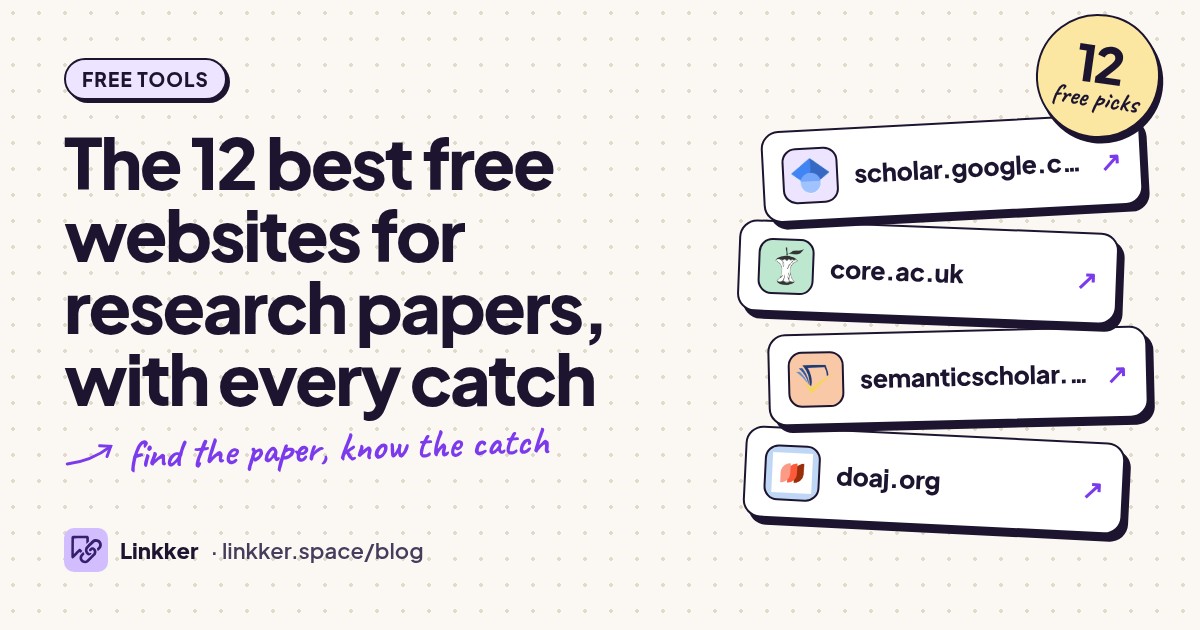
These are the best free websites for research papers for students, independent researchers, and anyone who needs evidence they can actually read.
Each qualifies because its core paper-search or reading job is free without a trial timer, although search engines can still return paywalled results and preprint archives include work that has not passed peer review.
-
Search scholarly literature across subjects and find available free versions.
Start here when you have a topic, an author, or a paper title but no idea which database covers it. Google Scholar searches broadly, and its useful trick is All versions: a publisher result may have a freely readable manuscript elsewhere. Look for PDF links beside results, then use Cited by to follow later work. It suits most readers as a first search, provided you distinguish finding a paper from getting its full text. Google’s search help explains those access options.
- Best for
- A first search across disciplines
- The catch
- Searching is free, but many results lead to subscription articles; a free full-text version is not guaranteed.
-
Find open research collected from university repositories and journals.
Try CORE when a promising title keeps leading back to a publisher’s payment screen. It collects research from repositories and journals, making it useful for locating deposited manuscripts as well as published articles. Search an exact title first, then broaden to topic terms if needed. Its standout strength is bringing scattered repository material into one place. Students without institutional access should keep it close, while checking which manuscript version they have found. CORE’s overview describes its sources and open-access mission.
- Best for
- Finding repository copies of papers
- The catch
- Some records contain bibliographic details rather than an available full-text file, and manuscript versions can differ.
-
Discover related papers with AI-assisted search and short summaries.
Semantic Scholar helps turn one relevant paper into a reading list. Its AI-assisted discovery is useful when you need related work, while TLDR summaries on supported papers help you decide what deserves a closer read. Treat those summaries as screening aids and verify claims in the original text. This is a practical starting point for readers looking for free AI tools for research. Its FAQ confirms that the search and discovery tool is free; access to every indexed paper is a separate matter.
- Best for
- Finding related studies and screening results
- The catch
- Some linked papers remain paywalled, and AI summaries are not available for every paper.
-
Find articles and journals that publish fully open-access research.
Use the Directory of Open Access Journals when you want journal research that readers can access freely. Its distinguishing feature is its journal inclusion criteria, rather than simply gathering anything labeled academic. Choose article search when you need a paper; choose journal search when you are investigating a publication. It is especially useful for students assembling a bibliography across disciplines and languages. DOAJ’s explanation sets out its focus on quality, peer-reviewed, open-access journals.
- Best for
- Finding open-access journal articles
- The catch
- It covers included open-access journals, so it will miss relevant research published elsewhere.
-
Read free full-text biomedical and life sciences journal literature.
Choose PubMed Central, or PMC, when you need to read a health or biology paper beyond its abstract. Unlike PubMed’s broader citation database, PMC is specifically a full-text archive. That makes it a straightforward place to examine methods, results, and references without discovering a payment screen halfway through. It suits students and independent readers researching biomedical questions. The official homepage identifies the archive as free; inclusion still does not make every article equally strong evidence.
- Best for
- Reading complete biomedical papers
- The catch
- Coverage centers on biomedicine and life sciences, and many papers found in PubMed are absent from PMC.
-
Read openly available papers in mathematics, computing, physics, and related fields.
arXiv is a strong destination for technical research, particularly computer science, mathematics, and physics. Browse a subject category when your terminology is still developing, or search a title when you already know the paper. Check the version history and any journal reference before citing: an early manuscript may differ from the published article. It suits readers who need access to developing research and can evaluate preliminary findings. The archive’s homepage clearly states that arXiv does not peer-review its materials.
- Best for
- Technical papers and emerging research
- The catch
- arXiv does not peer-review submissions, and an uploaded manuscript may differ from its eventual journal version.
-
Find education research, reports, and freely available full-text documents.
ERIC is a focused choice for teaching, learning, school policy, and education research. Select Full text available on ERIC to keep your search useful without a library subscription. Add the separate peer-reviewed filter when your assignment requires journal evidence; reports and other documents can serve different purposes. Its education-specific indexing helps narrow broad classroom questions. The Institute of Education Sciences overview confirms that ERIC provides a collection of full-text materials free of charge.
- Best for
- Education assignments and policy research
- The catch
- Many indexed records lack free full text; reports and other materials are not automatically peer-reviewed.
-
Read open-access research directly from a scientific publisher.
PLOS is useful when you want published research with the full article available at its source. Its journals cover topics including biology, medicine, climate, and public health. Start with the journal closest to your question, then inspect the methods and supporting information rather than stopping at the abstract. This is a good option for readers who prefer browsing a publisher’s collection to sorting mixed search results. PLOS confirms that its journals are free to read, share, and reuse.
- Best for
- Reading published open-access science
- The catch
- You are searching one publisher’s journals, so you need other sources for a broader literature review.
-
Search life sciences literature spanning abstracts, full-text articles, and preprints.
Europe PMC suits a broader biomedical search that includes both published literature and preprints. It brings multiple content sources together, which helps when a research question crosses article types. Check whether a result offers full text and whether it is a preprint before adding it to your evidence. There is substantial overlap with PMC, so use it for its wider discovery scope rather than treating matching records as separate studies. EMBL-EBI’s introduction explains its free repository and coverage.
- Best for
- Searching across life sciences literature
- The catch
- Some results offer only abstracts, and preprints need to be distinguished from peer-reviewed publications.
-
Read biology preprints before their formal journal publication.
Use bioRxiv to follow developing work in genetics, neuroscience, ecology, and other life sciences. Its value is early access: authors can share findings and revised manuscripts before journal publication. Record the version you read and check for a later published article before citing. It is most useful for researchers following an active topic, rather than readers seeking an established conclusion. The official explanation confirms free access and makes clear that screening is not peer review.
- Best for
- Following emerging biology research
- The catch
- Preprints have not been peer-reviewed before posting, and their findings can change in later versions.
-
Free
Zenodo
zenodo.orgFind shared papers alongside research datasets, software, and other supporting material.
Zenodo is worth checking when you need the material behind a paper as well as the manuscript itself. Its records can bring research outputs such as publications, datasets, and software into the same search. Look closely at the resource type, version, and access label before downloading. It suits readers tracing a specific project or checking supporting work. Zenodo’s published principles explain that records identify their access status, including open, embargoed, restricted, and closed material.
- Best for
- Finding papers and supporting research outputs
- The catch
- Some files are restricted or embargoed, and a repository record does not establish peer review.
-
Free
Unpaywall
unpaywall.orgFind a legally available free copy while viewing a journal article.
Unpaywall handles a narrower job than the search sites above: it checks for an open copy when you visit a paper’s page. Install its desktop browser extension, open the article, and look for the green tab when a copy is available. It is useful after you have identified exactly what you want to read. The official extension page confirms that it is free and uses legally uploaded sources, including university and government repositories.
- Best for
- Checking a specific paper for an open copy
- The catch
- The extension requires desktop Chrome or Firefox and cannot provide a free copy when none is available.










How to choose between them
Start with Google Scholar for breadth, then check CORE for a repository manuscript or DOAJ for open-access journal research. If you already have a specific article, Unpaywall can check for a legal open copy.
Your subject should guide the next step: PMC for complete biomedical articles, ERIC for education, and arXiv for technical fields. Use Semantic Scholar to expand a promising reading list. Preprints belong in your search when early findings matter, with their publication status clearly recorded.
Before citing, check the article’s version, methods, publication status, and any correction or withdrawal notice. Two websites hosting the same study are still one source. Save the article title, DOI, and useful link together; these free Pocket alternatives for organizing links can help keep a reading queue manageable.
Quick answers
What is the best free AI for research?
Semantic Scholar is a strong starting point for finding papers and screening supported results with short AI summaries. The best AI tools for research still require you to read the underlying studies; a summary does not establish that a conclusion is reliable.
What are the best websites for MUN research?
For Model United Nations, use official UN documents and your assigned country’s government statements as primary sources. Google Scholar and DOAJ can add academic context, but a research paper does not establish a country’s official position.
Can I read research papers for free without a university login?
Yes. PMC, arXiv, bioRxiv, and PLOS provide freely readable papers, while CORE and DOAJ help locate open research. Coverage varies, and no legitimate service guarantees free access to every published article.